Glaciers are formed when snow remains in the same place throughout the year, and enough builds up to turn it into ice. New layers of snow bury and compress the previous layers. This compression causes the snow to re-crystallise, forming grains similar in size to sugar. These grains gradually grow larger and the air-pockets among the grains get smaller, causing the snow to compact and increase in density. Crystals can reach several inches in length in older glaciers.
The fact that glaciers deform, added to their sheer weight and the force of gravity, causes glaciers to flow downhill.
Glaciers periodically retreat or advance, depending on the amount of snow they gain or lose. This movement takes a very long time, with more rapid movementh only being noticible over several months or years.
Showing posts with label Snow. Show all posts
Showing posts with label Snow. Show all posts
Thursday, 8 March 2012

Friday, 2 March 2012
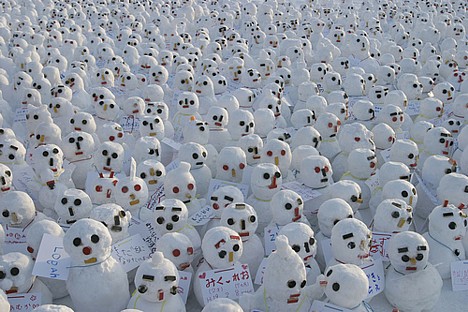
Snow can be used to build structures and sculptures, from simple snowmen:
 To larger and more complicated sculptures:




Sunday, 26 February 2012
Snow
Snow is not frozen rain, rather it is water vapour that condenses directly into ice, within clouds.
The simplest snowflakes are hexagonal prisms. The shapes of snowflakes depend on temperature and humidity. Thin plates and star shaped snowflakes form at around -2°C(28°F). Slender needles and columns appear close to -5°C(22°F). Stars and plates form again at -15°C(5°F) approximately, and a mixture of columns and plates forms close to -30°C(-22°F).
Snowflake shapes become more complicated with higher humidity, and simpler with lower humidity.
The simplest snowflakes are hexagonal prisms. The shapes of snowflakes depend on temperature and humidity. Thin plates and star shaped snowflakes form at around -2°C(28°F). Slender needles and columns appear close to -5°C(22°F). Stars and plates form again at -15°C(5°F) approximately, and a mixture of columns and plates forms close to -30°C(-22°F).
Snowflake shapes become more complicated with higher humidity, and simpler with lower humidity.
Subscribe to:
Posts (Atom)