To larger and more complicated sculptures:
Showing posts with label Snowflakes. Show all posts
Friday, 2 March 2012
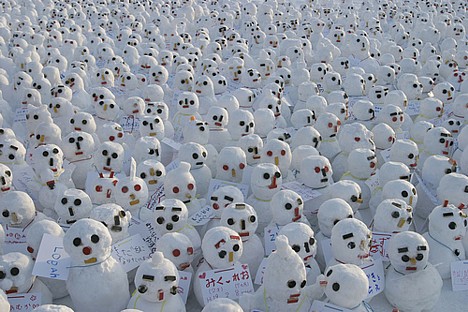
Snow can be used to build structures and sculptures, from simple snowmen:
To larger and more complicated sculptures:
Labels:
Ice,
Images. Ice,
Precipitation,
Snow,
Snowflakes
Sunday, 26 February 2012
Snow
Snow is not frozen rain, rather it is water vapour that condenses directly into ice, within clouds.
The simplest snowflakes are hexagonal prisms. The shapes of snowflakes depend on temperature and humidity. Thin plates and star shaped snowflakes form at around -2°C(28°F). Slender needles and columns appear close to -5°C(22°F). Stars and plates form again at -15°C(5°F) approximately, and a mixture of columns and plates forms close to -30°C(-22°F).
Snowflake shapes become more complicated with higher humidity, and simpler with lower humidity.
The simplest snowflakes are hexagonal prisms. The shapes of snowflakes depend on temperature and humidity. Thin plates and star shaped snowflakes form at around -2°C(28°F). Slender needles and columns appear close to -5°C(22°F). Stars and plates form again at -15°C(5°F) approximately, and a mixture of columns and plates forms close to -30°C(-22°F).
Snowflake shapes become more complicated with higher humidity, and simpler with lower humidity.
Subscribe to:
Posts (Atom)