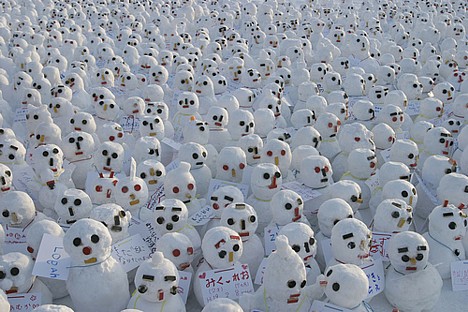
Snow can be used to build structures and sculptures, from simple snowmen:
To larger and more complicated sculptures:
Freezing rain is a form of precipitation that involves rainfall with temperatures below freezing. The rain is supercooled when passing though a sub-freezing layer of air, several hundred metres above the Earth. The rain then freezes upon impact. The resulting ice is called glaze. If a storm produces a large amount of glaze ice, it is referred to as an ice storm.
Glaze ice can cause many hazards, as it causes roads to be unsafe, and it changes the shape of aircraft, making flight more difficult. Plants also suffer greatly under freezing rain.
Hail is a form of precipitation that consists of balls or lumps of ice. It normally occurs during a thunderstorm or the passage of a cold front. If hail reaches the ground during a thunderstorm, it is then known as a hailstorm.
Hailstones begin as very small ice pellets which water droplets attach themselves to. The water then freezes, as the wind throw the pellets further into the sky, increasing the size of the pellets.
The more this happens, the bigger the hailstone gets.
Larger hailstones indicate powerful updraft and downdraft winds in a thunderstorm. Large hailstones are therefore associated with severe hailstorms.
Hailstone can vary in size, bigger ones are rarer than smaller ones. Hailstones bigger than 4.5inches(11.43cm) are especially rare.
Snow is not frozen rain, rather it is water vapour that condenses directly into ice, within clouds.
The simplest snowflakes are hexagonal prisms. The shapes of snowflakes depend on temperature and humidity. Thin plates and star shaped snowflakes form at around -2°C(28°F). Slender needles and columns appear close to -5°C(22°F). Stars and plates form again at -15°C(5°F) approximately, and a mixture of columns and plates forms close to -30°C(-22°F).
Snowflake shapes become more complicated with higher humidity, and simpler with lower humidity.
Normally, water freezes to become ice at 0° Celcius, 32° Fahrenheit and 273.15 Kelvin.
If there is a foreign substance in the water, the freezing point is lowered.
For every mole of a substance, such as salt, added to the water, the freezing point is reduced by approximately 1.8°C.
Basically the more stuff added to the water, the colder it needs to be to freeze.